


Schema and AI Search: What the Research Actually Says

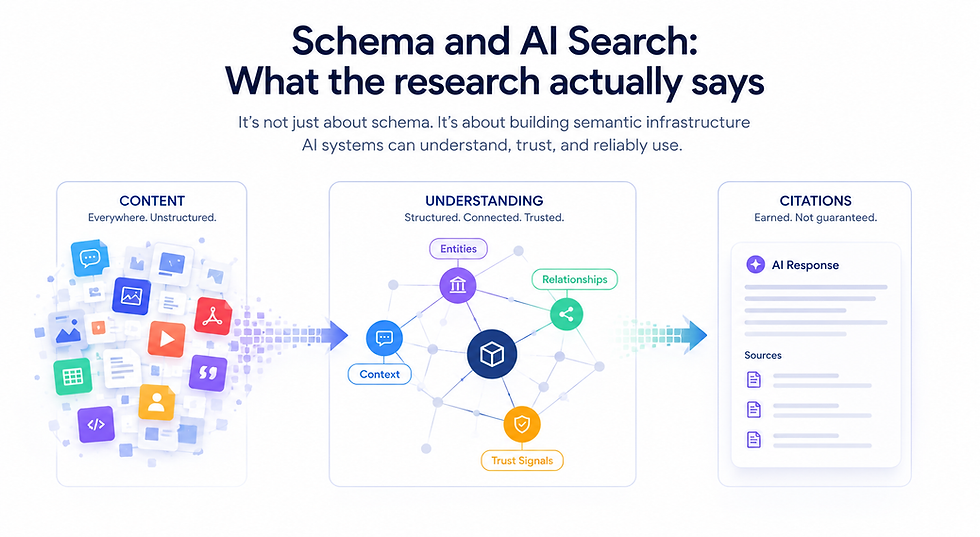
There’s a debate running hot in SEO right now, and it centers on a deceptively simple question: does schema markup help your content get cited by AI search engines?
The answer may surprise you, and the research behind it is worth digging into.
Featured: Real-World Data Ahead Enterprise SEO practitioners are seeing results that basic schema studies are not designed to detect. Martha van Berkel, CEO of Schema App, shares client outcomes including 116% impressions increase at InSinkErator, a 113% click increase at Henry Ford Health, and a brand protection case at Wells Fargo where advanced schema corrected AI hallucinations in real time. See the Practitioner Perspective section below. |
The Correlation Trap
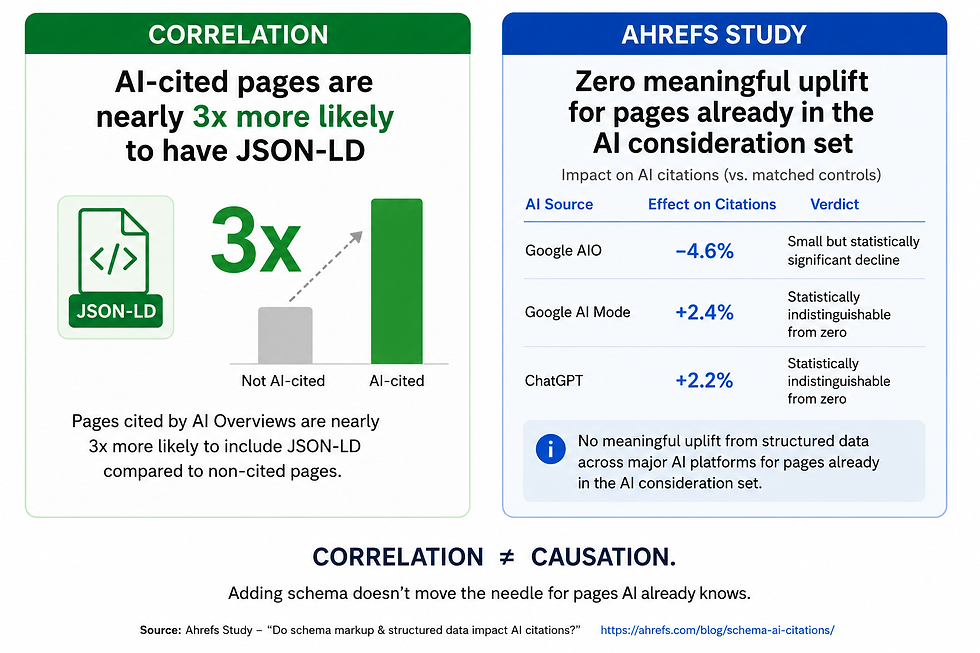
Start with a number that gets shared constantly in LinkedIn carousels and conference slides: AI-cited pages are nearly three times more likely to have JSON-LD schema than pages that are not cited. That statistic comes from a May 2026 study by Louise Linehan and Xibeijia Guan at Ahrefs, who analyzed six million URLs to kick off a larger controlled experiment.
It sounds like proof. It isn’t.
The Ahrefs team followed that correlation with a controlled study tracking 1,885 pages that added JSON-LD schema between August 2025 and March 2026, matched against 4,000 control pages. They measured citation changes across Google AI Overviews, AI Mode, and ChatGPT using a difference-in-differences methodology designed to strip out platform-wide trends. The result: adding schema produced no meaningful uplift in citations on any platform. AI Mode and ChatGPT showed changes so small they were statistically indistinguishable from random noise. AI Overviews showed a decline of 4.6%, which was statistically significant but small in absolute terms and potentially attributable to factors other than schema.
But there are two scope constraints most people reading the headline will miss. First, every single page in that dataset already had 100+ AI Overview citations before the study began. These pages were already inside the AI consideration set, already crawled, already surfaced, already known to the systems being measured.
Second, the study pooled all schema types together, treating Article, FAQ, Product, HowTo, and Organization markup as variations of the same thing. They are not. As we will see, that distinction turns out to matter a great deal.
In a response published the same day, SEO analyst Gianluca Fiorelli put the first constraint well: this is like testing whether adding a label to a bottle already on the supermarket shelf makes customers pick it up more often. The shelf placement already happened. The question of how the bottle got on the shelf in the first place is a different study entirely.
The Ahrefs team’s own explanation for the original correlation is the most honest framing in the piece: schema tends to live on better-maintained, more technically sophisticated sites, and those same sites publish stronger content, build more authority, earn more links, and do everything else that earns citations. Schema is not the driver. It’s a marker for sites that do the actual work. But as Fiorelli notes, that correlation may also be pointing at something real: the same sites that implement structured data tend to be the same sites that have invested in their entity presence, including Knowledge Graph entries, organization schema, and sameAs connections to authoritative external sources. Those things are genuinely correlated with AI visibility, and a 30-day citation window may simply be too narrow to detect them.
The Technical Argument, and Where It Gets Complicated
In a May 2026 piece in The Inference, Pedro Dias made the architectural case for why schema does not work the way GEO vendors claim. His argument: large language models parse text by reading text. There is no schema parser inside the model looking for structured data tags. The transformer architecture processes language as sequences of tokens and does not read microdata. Schema.org has well-defined jobs in classical search, including rich results, Knowledge Graph entity disambiguation, and voice assistants, but those functions are not the mechanism by which an LLM understands your content at query time.
The Ahrefs study adds empirical weight here, referencing a separate experiment from searchVIU in which five major AI systems, ChatGPT, Claude, Perplexity, Gemini, and Google AI Mode, were observed fetching pages in real time. None of them used schema during direct retrieval. Every system extracted visible HTML content only.
Google’s own Guide to Optimizing for Generative AI Features is characteristically ambiguous on structured data. Under a section titled “Overfocusing on structured data,” Google states that schema.org markup is not required for generative AI search and there is no special markup to add, while still recommending it as part of an overall SEO strategy. What Google will not say is where the line is. More pointedly, the same guide tells publishers to ignore “AEO/GEO hacks” including content chunking, llms.txt files, and inauthentic mention-seeking -- a direct rebuke of the prescriptive GEO playbook most vendors are selling. That ambiguity, and that rebuke, are precisely why the research in this article matters: it fills the gap Google won’t. The evidence points to schema’s value operating upstream of the AI generation layer, at indexing and entity resolution, which is a different question entirely from whether it triggers citations directly.
That finding is real, but it describes retrieval-time behavior, one specific moment in a multi-stage pipeline. It says nothing about what happens during Google’s indexing and entity parsing processes, or during Knowledge Graph construction, all of which happen well upstream of the moment an AI retrieves a page to answer a query. Fiorelli draws the distinction precisely: conflating “the AI ignored JSON-LD when fetching this page” with “JSON-LD has no effect on how AI systems understand or represent this entity” is a category error. Google’s own documentation is explicit that structured data helps it understand page content and gather information about entities such as people, organizations, and companies. That understanding happens at index time, not at query time.
Fiorelli offers the analogy that clarifies this best: schema is less like placing an ad and more like registering a company. You do not register a company expecting the act of registration to immediately drive revenue. You register it because, without that registration, the company does not exist as a verifiable entity in any official system. The downstream benefits depend on the registration being complete and accurate, but you cannot measure those benefits by asking whether revenue went up in the 30 days after registration.
Schema’s work happens earlier in the pipeline, at the indexing and entity resolution stage, where the representation of your entity in machine-readable systems is either clear or it is not.

The FAQ Rich Result Question
On May 7, 2026, Google stopped showing FAQ rich results in standard search. For teams who had leaned on FAQ schema as a visibility tactic, this felt like the floor falling out.
In a May 2026 article on LinkedIn, A.L. MacFarland put this in the right context: what disappeared was the visible Google reward, not the underlying value of FAQ content. MacFarland traces the pattern clearly: new SERP feature appears, early adopters gain visibility, the tactic becomes templateable, scaled implementation overtakes genuine user value, Google removes the reward. FAQ rich results followed this arc from 2023 through 2026.
Google’s own guidance from 2023 still applies: there is no need to proactively remove valid FAQ structured data. Unused schema does not cause problems. It just no longer generates expanded listings.
Where FAQ schema still earns its keep is outside of Google Search entirely. Bing and the Microsoft ecosystem actively process structured data to enhance search results, and other schema-aware systems and indexing pipelines continue to use markup to interpret page relationships and classify content. The markup may not expand your Google listing anymore, but it still helps systems understand what a page is about and what question it answers.
The more important shift MacFarland identifies is strategic. The old job of FAQ content was SERP expansion. The modern job is answer clarification, defining the scope of a question, the conditions under which an answer changes, and the evidence that supports it. That is a more durable function because it supports understanding rather than interface decoration.
What Actually Moves the Needle
The academic paper most often cited as the foundation for GEO as a discipline, Aggarwal et al.’s GEO: Generative Engine Optimization presented at the ACM Knowledge Discovery and Data Mining (KDD) Conference in 2024, tested nine optimization methods and found the biggest visibility lifts came from adding citations from credible sources, adding statistics, and improving prose fluency. The methods that produced the largest gains were essentially: write content with more evidence in cleaner language. Schema was not tested. Heading hierarchy was not tested. FAQ markup was not tested. Because those were not the optimization surface the research was studying.
A 2026 practitioner analysis from Search Engine People makes the same point: AI engines and Google both reward subject matter expertise. Topical authority, built through depth, documented results, and consistent publication under real names, is what creates the conditions for citation. Structured data is table stakes technical hygiene. It is not a citation lever.
A 2025 survey of 400 senior B2B marketing executives by 10Fold and Sapio Research adds market context: 35% of B2B marketers now cite GEO performance as their top success benchmark, ahead of both brand awareness and SEO. AI-native platforms like ChatGPT and Perplexity have become the second most common source for qualified leads among B2B tech buyers. The shift is real. The question is whether the industry’s prescribed response to it is.
A Coherent Position
Here is what the research, taken together, actually supports:
Schema still belongs in your toolkit. For rich results where they exist, Knowledge Graph entity disambiguation, crawlability, and answer extractability in non-Google environments. Do not panic-remove it. Do not stop implementing it on new builds.
Schema is not a short-term AI citation lever, particularly for pages already in the AI consideration set. The Ahrefs data is clear: if a page is already being crawled and surfaced, adding JSON-LD is not going to push it higher in AI-generated answers.
Entity schema and content schema are not the same thing, and treating them as interchangeable is one of the industry’s biggest methodological errors. As Fiorelli points out, Organization, Person, and sameAs schema are entity identity signals. Article, FAQ, and HowTo schema are content signals. The Ahrefs study pooled all of these together, which is why it could not detect entity-level effects that operate on a much longer timeline.
For entities not yet established in the Knowledge Graph, including organizations without a Knowledge Panel, brands with disambiguation problems, and individuals whose entity record conflates them with others, structured data implemented correctly remains one of the most important investments you can make. Not because it will move citation counts in 30 days, but because entity disambiguation is the foundation on which everything else is built.
Content quality is the actual lever. Credible sources, real evidence, clear prose, demonstrated expertise, consistent publication under real names. These are the signals that show up in every piece of credible research on AI visibility, and they are what has always made content worth reading.
The visible rewards attached to easily repeated markup are fragile by design. The foundations underneath them are not.
Practitioner Perspective: Martha van Berkel, CEO, Schema App
To ground this research synthesis in real-world practice, I reached out to Martha van Berkel, CEO of Schema App, whose team has been working at the intersection of structured data and AI visibility across enterprise implementations. Her perspective adds an important dimension that most studies miss entirely.
Not All Schema Implementations Are Equal
The most important nuance Martha raises is one that undermines much of the current research, including the Ahrefs study: most evaluations treat all schema markup as a single category, despite fundamental differences between basic page-level markup designed for rich results, and comprehensive semantic implementations designed to support entity understanding, contextual grounding, and machine-readable relationships across an entire website.
That distinction matters more than any citation count. As Martha explains, AI systems are no longer simply retrieving pages. They are interpreting entities, inferring relationships, deciding what to trust, and determining how brands are represented. In that environment, visibility without understanding becomes fragile, and creates brand risk due to inaccurate representation.
Schema App’s approach goes well beyond generic schema.org typing, isolated page markup, or FAQ-focused optimization. Implementations are designed to create a connected semantic layer using entity linking, persistent entity identifiers (@id), sameAs reconciliation, relationship modeling, and content knowledge graph development. The goal, as Martha frames it, is not simply to generate rich results, but to improve how AI and search systems interpret, connect, and confidently represent entities across the web.
Three Questions That Matter More Than Citation Count
Martha reframes the measurement question entirely. Rather than asking whether schema increases citations, she suggests the more useful questions are:
Can you be found in search and AI Overviews for the right queries?
Does AI understand and represent you correctly when you are found?
Can your semantic layer power AI-native and agentic experiences?
Real-World Results from Advanced Semantic Implementation
Across several enterprise implementations focused on entity understanding and connected context, Schema App has observed meaningful outcomes that basic schema studies simply are not designed to detect:
SchemaApp.com saw a 19.72% increase in AI Overview visibility for entity-related queries following entity linking implementation.
Brightview Senior Living saw a 25% increase in clicks and a 30% increase in impressions for non-branded entity queries after strengthening entity linking.
InSinkErator observed a 69% increase in clicks and a 116% increase in impressions for non-branded product queries after implementing advanced semantic markup and entity linking.
Henry Ford Health implemented entity linking and knowledge graph strategies and observed a 113% increase in clicks and a 119% increase in impressions year-over-year on optimized pages.
Wells Fargo used connected schema markup and entity-grounded context to address inaccurate AI-generated branch closure information appearing in AI Overviews. After implementation, AI systems began citing the authoritative branch page rather than outdated third-party information.

The Wells Fargo example is worth pausing on. This is not a visibility story. It is a brand protection story. AI systems were hallucinating incorrect information about branch closures, and schema markup was the mechanism used to correct that. As AI-generated answers become a primary touchpoint for consumers, the cost of inaccurate entity representation grows significantly.
Martha’s observation from these implementations is that comprehensive semantic approaches may help AI and search systems better disambiguate entities, improve contextual understanding, expand retrieval relevance across non-branded queries, reduce inference errors, and increase confidence in how brands and content are represented.
A note on scope: everything in this article focuses on Google’s pipeline specifically, and that distinction matters more than it used to. A recent analysis by Duane Forrester makes the case that the portability of SEO guidance across search engines, the quiet assumption that optimizing for Google roughly covered everyone else, does not exist in LLM-land. OpenAI, Anthropic, Google, and Perplexity train on different corpora, run different crawlers, and apply fundamentally different retrieval architectures. Qwairy’s analysis of 118,000 AI responses across ChatGPT, Perplexity, Google AI Mode, and Claude found that only 11% of cited domains appeared across multiple platforms. The other 89% were platform-specific. Schema’s role in Google’s indexing and entity resolution pipeline is the argument this article makes. Whether that role transfers to Claude, ChatGPT, or Perplexity is a separate question this article does not answer, and one the industry is only beginning to study seriously.
Practical Takeaways
If you are managing schema for a client or your own site right now:
Keep FAQ schema where it answers real user questions with specific, evidence-backed answers. Remove it where it exists purely for markup.
Stop positioning basic schema as a GEO tactic in client conversations. The data does not support that framing, at least not as a short-term citation driver.
Prioritize entity schema for any brand not yet well-established in Google’s Knowledge Graph. Organization, Person, sameAs. This is infrastructure work. It does not show up in 30-day citation reports, but it determines whether AI systems treat your brand as a resolvable, trustworthy entity at all.
Consider the difference between basic schema and advanced semantic implementation. Entity linking, persistent identifiers, sameAs reconciliation, and relationship modeling operate at a different level than page-level JSON-LD. The results Martha’s team has observed suggest that distinction matters more than most current studies can measure.
Audit your FAQ content. Does each question reflect a real user decision? Is the answer visible on the page, specific, supported by evidence, and aligned with the page’s core purpose? If not, it is decoration.
Invest in topical authority. Depth, real expertise, documented results, real author credentials. This is what the academic research and the practitioner data both point to.
Track AI citations separately from organic rankings. GEO performance is becoming a real KPI. Understand your baseline before you make changes so you can actually measure what is working.
The debate about schema and AI search is not really about schema. It is about whether there is a controllable technical discipline sitting between a publisher and an AI citation, one that looks enough like classical SEO to be familiar, billable, and reportable. The research this week suggests that discipline does not exist in the form being sold.
What does exist is something more fundamental and more durable. As Martha van Berkel frames it, the right question is not whether schema markup increases AI citations. The right question is how we create semantic infrastructure that helps AI systems understand, trust, and reliably use our data.
That is a harder problem than adding JSON-LD to a page. It is also the one that still matters.


Comments